science
solid-phase peptide synthesis (spps), explained
how solid-phase peptide synthesis builds a peptide one amino acid at a time on a resin, the fmoc and boc approaches, and why synthesis errors show up on a coa.
Solid-phase peptide synthesis (SPPS) is the standard method for chemically making a peptide, building the chain one amino acid at a time on an insoluble resin bead. It is the reason research-grade peptides can be produced with defined sequences at scale, and understanding it explains where the impurities a Certificate of Analysis measures actually come from. The method was introduced by Bruce Merrifield in 1963 and earned him the Nobel Prize in Chemistry in 1984.
the core idea: anchor, then build
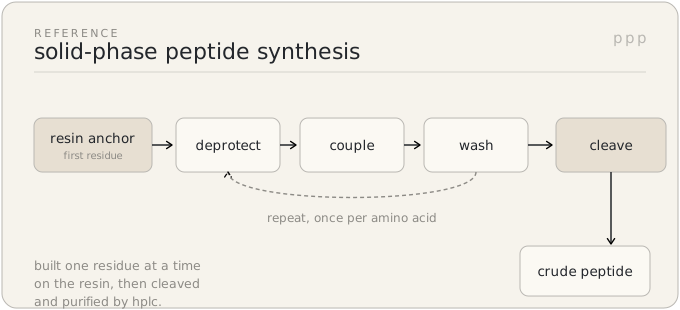
The insight behind SPPS is to attach the growing peptide to something solid so that excess reagents and byproducts can simply be washed away at each step. The first amino acid (the eventual C-terminus) is anchored to a resin bead. Then the chain is extended toward the N-terminus by repeating a short cycle:
- Deprotect. The reactive amino group at the top of the chain is protected by a chemical group; it is removed so the next amino acid can attach.
- Couple. The next amino acid, itself protected on its own reactive groups, is activated and joined to the chain.
- Wash. Excess reagents and byproducts are rinsed away, leaving only the resin-bound chain.
That cycle repeats once per amino acid. When the full sequence is assembled, the peptide is cleaved from the resin and its remaining protecting groups are removed, yielding the crude peptide. The wash-and-repeat logic is what makes the process automatable, and modern synthesizers run these cycles unattended.
two chemistries: Fmoc and Boc
The protecting-group strategy defines the two dominant approaches:
| Fmoc chemistry | Boc chemistry | |
|---|---|---|
| Temporary protecting group | Fmoc (base-removable) | Boc (acid-removable) |
| Cleavage from resin | Milder acid (TFA) | Stronger acid (HF) |
| Handling | More common today; milder conditions | Older; used for certain difficult sequences |
| Everyday note | The default for most research peptides | Specialized applications |
Fmoc chemistry, using milder conditions, is the workhorse for most contemporary peptide synthesis; Boc chemistry remains useful for particular sequences. Both build the same peptide bonds; they differ in how the protecting groups are added and removed.
where impurities come from
Because SPPS is a repeated cycle, a small inefficiency at one step propagates. The two most common outcomes are worth knowing because they are exactly what analytical testing looks for:
- Deletion sequences. If a coupling step is incomplete, some chains skip an amino acid. The result is a peptide missing one residue, which a mass-spectrometry identity test can catch as a mass lower than expected.
- Related-substance impurities. Side reactions and incomplete deprotection produce a family of closely related molecules, which show up as minor peaks on an HPLC purity trace.
This is the direct link between how a peptide is made and what its COA reports: purity and identity testing exist precisely to characterize the byproducts of synthesis.
purification: the step after synthesis
Crude peptide from the cleavage step is not the finished material. It is purified, most often by preparative reverse-phase HPLC, which separates the target peptide from the deletion sequences and related substances. The purified fraction is then lyophilized to a dry powder and characterized. Only after that testing does material become research-grade. For how the finished product is stored, see the handling cluster; for how it is verified, see reading a Certificate of Analysis.
a note on history
Merrifield's 1963 paper described synthesizing a tetrapeptide on a solid support, a departure from the laborious solution-phase methods of the time. The approach turned peptide synthesis from a specialist, weeks-long undertaking into a repeatable, ultimately automated process, which is why it was recognized with a Nobel Prize and why essentially all research peptides today trace back to it. For the fundamentals of what is being built, see what is a peptide.
frequently asked questions
What is solid-phase peptide synthesis?
It is the standard method for chemically making a peptide by anchoring the first amino acid to an insoluble resin and adding the rest one at a time through a repeated deprotect-couple-wash cycle, then cleaving the finished chain from the resin. It was introduced by Bruce Merrifield in 1963.
What is the difference between Fmoc and Boc synthesis?
They are two protecting-group strategies. Fmoc uses base-removable protection and milder acid for final cleavage, and is the more common approach today. Boc uses acid-removable protection and a stronger acid for cleavage, and is used for certain difficult sequences. Both form the same peptide bonds.
Why do synthesized peptides contain impurities?
Because synthesis is a repeated cycle, small inefficiencies produce byproducts such as deletion sequences (chains missing a residue) and related substances (from side reactions). These are then removed by purification and quantified by HPLC purity and mass-spectrometry identity testing.
How are peptides purified after synthesis?
Crude peptide is typically purified by preparative reverse-phase HPLC, which separates the target peptide from synthesis byproducts. The purified material is lyophilized and characterized before it is considered research-grade.
references
- Merrifield, R. B. (1963). Solid Phase Peptide Synthesis. I. The Synthesis of a Tetrapeptide. Journal of the American Chemical Society, 85(14), 2149-2154. https://doi.org/10.1021/ja00897a025
- The Nobel Prize in Chemistry 1984 (Bruce Merrifield), Nobel Foundation. https://www.nobelprize.org/prizes/chemistry/1984/
- U.S. Pharmacopeia, General Chapter <1503> Quality Attributes of Synthetic Peptide Drug Substances. https://www.usp.org/
continue reading
research use only. sold for in-vitro laboratory research.
not for human or animal use.