
science
what is a peptide? a researcher's primer
what a peptide is, how it differs from a protein, how peptides are made and named, and why they are studied so widely in the research literature.
A peptide is a short chain of amino acids joined by peptide bonds. It sits in the chemical middle ground between small molecules and proteins: larger and more complex than a typical small-molecule compound, smaller and simpler than a protein. That middle position is what makes peptides interesting to researchers, and it is also what makes them demanding to handle and to characterize. This primer is the hub for the science cluster; the linked articles go deeper on synthesis and terminology.
amino acids and the peptide bond
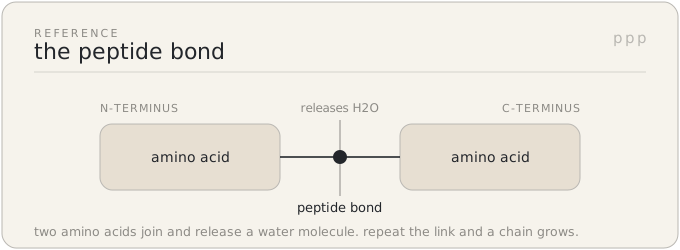
The building block is the amino acid. Twenty standard amino acids make up the common alphabet, each with a shared backbone and a distinct side chain that gives it its chemical character (charged, polar, or hydrophobic). When two amino acids join, the amino group of one reacts with the carboxyl group of the other, releasing a water molecule and forming a peptide bond. Repeat that linkage and a chain grows.
Because the chain has a direction, it has two distinct ends: the N-terminus (free amino group) and the C-terminus (free carboxyl group). By convention, a peptide sequence is written and numbered from N-terminus to C-terminus. Sequences are notated with three-letter (Gly-Pro-Arg) or one-letter (GPR) amino acid codes.
peptide versus protein: a question of size
There is no single hard boundary, but the working convention is one of length:
| Small molecule | Peptide | Protein | |
|---|---|---|---|
| Building blocks | Varies | Amino acids | Amino acids |
| Typical size | Tens of daltons to a few hundred | A few to about 50 amino acids | Dozens to thousands of amino acids |
| Structure | Rigid, defined | Primary sequence, sometimes limited folding | Complex folded three-dimensional structure |
| Handling | Often robust | Sensitive to heat, moisture, light | Sensitive, often requires cold chain |
Peptides shorter than a handful of residues are sometimes called oligopeptides; longer chains that begin to fold are called polypeptides, and once a chain folds into a stable functional structure it is generally called a protein. The categories blur at the edges, which is normal in chemistry.
structure: mostly sequence
A protein's behavior depends heavily on how it folds. A peptide is defined primarily by its primary structure, the linear order of its amino acids, though longer peptides can adopt some local secondary structure (helices or turns). For most research-grade peptides, the sequence is the identity, which is why analytical confirmation of that sequence, by mass and by purity, is the core of a Certificate of Analysis. See what is HPLC and how it measures peptide purity.
why peptides are studied
Peptides function as signaling molecules throughout biology: the body uses short amino acid chains to carry messages between cells and systems. Because a peptide's sequence determines which molecular targets it interacts with, peptides can be highly specific, and that specificity is what makes them a large and active area of the research literature. Published studies examine peptides as tools for understanding signaling, as subjects of chemistry and analytical method development, and as objects of pharmacological research. In every case here, the frame is the same: peptides are studied, and pur path project supplies them for that laboratory study.
how peptides are made
Two broad routes produce peptides:
Chemical synthesis, most commonly solid-phase peptide synthesis (SPPS), builds a peptide one amino acid at a time on a solid support. It is the dominant method for research-scale peptides and is covered in solid-phase peptide synthesis, explained.
Recombinant expression uses living cells engineered to produce a peptide or protein biologically. This route is more common for larger proteins than for short peptides.
After synthesis, a peptide is purified (typically by preparative HPLC) and characterized before it is considered research-grade material.
how to go deeper
The vocabulary in this article, from primary structure to counter-ion, is collected in the peptide and analytical chemistry glossary. The synthesis process is in the SPPS primer. And how a finished peptide is verified is the subject of the COA and analytical cluster, starting with reading a Certificate of Analysis.
frequently asked questions
What is a peptide in simple terms?
A peptide is a short chain of amino acids joined by peptide bonds. It is larger than a typical small-molecule compound but smaller than a protein, and it is defined mainly by the order of its amino acids (its sequence).
What is the difference between a peptide and a protein?
The difference is largely one of size and folding. Peptides are short chains, conventionally up to about 50 amino acids, defined mainly by their sequence. Proteins are longer chains that fold into complex three-dimensional structures. The boundary is a convention, not a sharp line.
What is a peptide bond?
A peptide bond is the covalent link formed when the amino group of one amino acid reacts with the carboxyl group of another, releasing water. These bonds joined in series form the backbone of a peptide chain.
Why are peptides studied so widely?
Peptides act as signaling molecules in biology, and because a peptide's sequence determines its molecular targets, peptides can be highly specific. That specificity makes them an active area of research in signaling, chemistry, and pharmacology.
references
- Nelson, D. L., & Cox, M. M. Lehninger Principles of Biochemistry (chapters on amino acids and peptides). W. H. Freeman.
- International Union of Pure and Applied Chemistry (IUPAC-IUBMB), Nomenclature and Symbolism for Amino Acids and Peptides. https://iupac.org/
- U.S. Pharmacopeia, General Chapter <1503> Quality Attributes of Synthetic Peptide Drug Substances (peptide characterization context). https://www.usp.org/
continue reading


research use only. sold for in-vitro laboratory research.
not for human or animal use.