analytical
what is hplc, and how it measures peptide purity
how hplc measures the purity of a research peptide, how the percentage on a coa is calculated, and what the number does and does not tell you.
High-performance liquid chromatography (HPLC) is the standard analytical method for measuring how pure a peptide is: what percentage of the material in a batch is the target peptide, and what percentage is everything else. When a Certificate of Analysis reports a peptide as "99.1% by HPLC," that number came from this method. Understanding how it is produced is the difference between reading a COA and trusting one.
This article explains what HPLC does, how a purity percentage is calculated from the result, and, just as importantly, what that percentage cannot tell you.
how hplc separates a peptide from its impurities
Chromatography works by pushing a sample through a system that different molecules travel through at different speeds. The molecules that interact more strongly with the system move slowly; the ones that interact weakly move quickly. By the time everything exits, the components have separated in time.
For peptides, the specific technique is almost always reverse-phase HPLC (RP-HPLC). The sample is dissolved and injected into a stream of liquid (the mobile phase, usually water and acetonitrile with a small amount of an acidic modifier) that flows through a column packed with a hydrophobic material (the stationary phase, typically a C18 carbon chain bonded to silica).
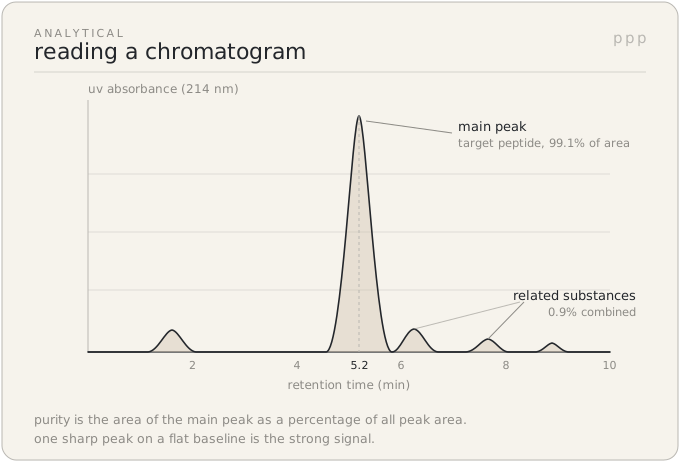
Peptides stick to that hydrophobic surface to varying degrees depending on their sequence and shape. As the proportion of acetonitrile is gradually increased (a "gradient"), each component releases from the column and flows past a detector. Most peptide analysis uses ultraviolet detection at 214 nm or 220 nm, wavelengths where the peptide bond itself absorbs light. The detector records a trace called a chromatogram: a series of peaks, each one a component of the sample, plotted against the time it took to emerge (its retention time).
how the purity percentage is calculated
The purity number on a COA is an area-percent calculation. The detector measures the area under each peak, which is proportional to how much of that component is present. Purity is the area of the main peak (the target peptide) divided by the total area of all peaks, expressed as a percentage.
purity (%) = (area of the target peak ÷ total area of all peaks) × 100
A batch reported at 98.5% means the main peak accounts for 98.5% of the total detected signal, and the remaining 1.5% is distributed across smaller peaks: synthesis byproducts, truncated sequences, or degradation products, collectively called related substances.
what the percentage does and does not tell you
This is where careful reading matters. An HPLC purity figure is precise, but it is narrow.
| HPLC purity tells you | HPLC purity does NOT tell you |
|---|---|
| The relative proportion of the target peptide versus other UV-absorbing components | Whether the main peak is actually the intended compound (that requires mass spectrometry for identity) |
| That the synthesis and handling produced few related-substance impurities | How much of the vial's mass is peptide versus water, salts, and counter-ions (that is net peptide content) |
| A consistent, comparable quality metric across batches | Whether the material is sterile or free of endotoxin (separate tests entirely) |
Three specific limitations are worth internalizing:
It is a relative measure, not an absolute one. Area-percent assumes every component responds to UV light similarly. That is an approximation. An impurity that absorbs weakly at 214 nm contributes a smaller peak than its true abundance, and a component that does not absorb at all is invisible to a UV detector.
A single wavelength can miss things. Rigorous analysis sometimes runs detection at more than one wavelength, or pairs HPLC with mass spectrometry, precisely because co-eluting or non-absorbing species can hide under or beside the main peak.
Purity is not identity. A batch can be 99% pure and still be the wrong peptide, if the synthesis produced a clean but incorrect sequence. This is why a credible COA reports HPLC purity and a mass-spectrometry identity result. The two answer different questions: HPLC asks "how much of one thing," mass spec asks "what is that thing." See LC-MS and peptide identity confirmation.
reading the trace itself
If a vendor publishes the actual chromatogram rather than just a number, a few features are worth looking at:
- A single, sharp, symmetrical main peak. Broad or tailing peaks can indicate column or method issues; a clean peak is a good sign.
- Small, well-separated minor peaks rather than a cluster of shoulders fused to the main peak. Fused shoulders can inflate the apparent purity because the integration software may not resolve them.
- A stated method and wavelength. A purity figure reported with its analytical conditions (column, gradient, detection wavelength) is far more meaningful than a bare percentage.
For how this figure fits alongside the other parameters on a certificate, see the pillar guide, reading a Certificate of Analysis.
frequently asked questions
Is HPLC purity the same as net peptide content?
No. HPLC purity is the proportion of the target peptide relative to other detected organic components. Net peptide content is how much of the vial's total dry mass is actually peptide, versus water and salts. A batch can be high on one and lower on the other. See what "99% purity" actually means.
What purity is typical for research-grade peptides?
Published and industry practice generally treats 95% and above as the working threshold for research-grade material, with higher-specification material often reported at 98% or 99% and above. The appropriate threshold depends on the research application.
Does HPLC confirm the peptide is the correct compound?
No. HPLC quantifies purity but does not confirm identity. Identity confirmation uses mass spectrometry, which compares the measured molecular mass to the theoretical mass of the intended sequence.
Why is the wavelength 214 nm?
The peptide bond absorbs ultraviolet light strongly near 214 nm, so detection at that wavelength captures essentially all peptide species in the sample, including those without aromatic side chains that would show up at 280 nm.
references
- U.S. Pharmacopeia, General Chapter <621> Chromatography. https://www.usp.org/
- International Council for Harmonisation, Q2(R1) Validation of Analytical Procedures: Text and Methodology. https://www.ich.org/
- U.S. Pharmacopeia, General Chapter <1058> Analytical Instrument Qualification. https://www.usp.org/
continue reading
research use only. sold for in-vitro laboratory research.
not for human or animal use.