analytical
lc-ms and peptide identity confirmation
how mass spectrometry confirms a research peptide is the compound the label claims, why identity is separate from purity, and how to read a mass result.
Mass spectrometry confirms a peptide's identity by measuring its molecular mass and comparing it to the theoretical mass of the intended sequence. If the two match within a small tolerance, the material is very likely the compound the label claims. This is the test that answers a question purity cannot: not "how much," but "what."
On a Certificate of Analysis, this usually appears as an "identity" or "mass" line, often reported from LC-MS (liquid chromatography coupled to mass spectrometry) or MALDI-TOF. Here is how it works and how to read it.
why identity is a separate question from purity
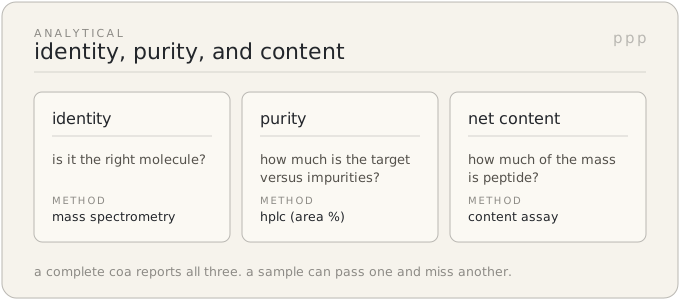
A common misreading of a COA is to treat a high HPLC purity figure as proof that the vial contains the right compound. It is not. HPLC purity measures the proportion of one dominant component against everything else. It says nothing about whether that dominant component is the intended peptide.
Consider a synthesis that runs cleanly but drops a single amino acid from the sequence. The result can be 99% pure by HPLC (one clean peak) and still be the wrong molecule. Only a measurement of the actual mass catches that error. Purity and identity are two independent checks, and a credible COA reports both.
how mass spectrometry measures a peptide
Every peptide has a precise molecular mass, calculable from its amino acid sequence. Mass spectrometry measures that mass directly.
The instrument does three things: it converts the peptide into gas-phase ions (ionization), it separates those ions by their mass-to-charge ratio (m/z), and it records how many arrive at each ratio. The output is a spectrum of peaks along an m/z axis. From that spectrum, the peptide's neutral molecular mass is determined and compared to the theoretical value.
Two ionization approaches dominate peptide work:
| Method | How it ionizes | What the spectrum looks like | Common use |
|---|---|---|---|
| ESI (electrospray), used in LC-MS | Sprays the sample from solution, producing multiply charged ions | Several peaks, each a different charge state; software "deconvolutes" them into one neutral mass | Coupled to HPLC, so purity and identity can run in one workflow |
| MALDI-TOF | Embeds the sample in a matrix and pulses it with a laser; time-of-flight measures mass | Predominantly single-charge peaks, simpler to read | Fast identity confirmation, tolerant of some sample complexity |
Because ESI can be run directly after an HPLC separation, LC-MS is especially useful: the same run that reports purity can also confirm the mass of the main peak.
reading a mass result
The COA reports an observed mass and, ideally, the theoretical (expected) mass. A match within the instrument's tolerance is a pass. Where the numbers differ, the size of the gap is often diagnostic:
- +16 Da: oxidation, frequently at a methionine residue.
- Missing one residue's mass: a deletion sequence from incomplete coupling during synthesis.
- +22 Da: a sodium adduct rather than a true structural change.
- A counter-ion difference: acetate versus trifluoroacetate salts shift the observed mass and are a formulation detail, not a sequence error.
A well-documented identity result states the method, the observed mass, the expected mass, and the charge states or adducts considered. If a certificate lists only "identity: pass" with no numbers, that is weaker evidence than a reported mass you can check against the sequence yourself.
where identity sits among the other COA parameters
Identity is the foundation of the certificate: if the material is not the right compound, no other parameter matters. In practice, researchers read a COA in a rough order of precedence: identity first (is it the right molecule), then purity (how clean), then content, endotoxin, and sterility depending on the application. The full sequence is covered in the pillar guide, reading a Certificate of Analysis. For definitions of the terms used here, see the peptide and analytical chemistry glossary.
frequently asked questions
What is the difference between LC-MS and MALDI-TOF for peptides?
Both measure molecular mass to confirm identity. LC-MS uses electrospray ionization and produces multiply charged ions that are deconvoluted into a mass; it pairs naturally with HPLC. MALDI-TOF uses a laser and a matrix, produces mainly singly charged ions, and gives a simpler spectrum. Either can confirm a peptide's identity.
Can mass spectrometry alone verify a peptide?
Mass spectrometry confirms the molecular mass, which is strong evidence of identity, but two different sequences can share the same mass. For definitive sequence confirmation, tandem mass spectrometry (MS/MS) or amino acid analysis adds another layer. For routine research-grade material, an intact-mass match plus HPLC purity is the common standard.
Why does the observed mass sometimes differ from the theoretical mass by 16?
A difference of about +16 Da usually indicates oxidation, most often of a methionine residue. It is a common, well-understood modification rather than a sign that the wrong peptide was made, though it should be noted and quantified.
Does a purity result confirm identity?
No. Purity and identity are independent. Purity measures how much of the sample is one component; identity measures whether that component is the intended molecule. A credible COA reports both.
references
- U.S. Pharmacopeia, General Chapter <1736> Applications of Mass Spectrometry. https://www.usp.org/
- U.S. Pharmacopeia, General Chapter <621> Chromatography. https://www.usp.org/
- International Council for Harmonisation, Q6A Specifications: Test Procedures and Acceptance Criteria for New Drug Substances. https://www.ich.org/
continue reading


research use only. sold for in-vitro laboratory research.
not for human or animal use.