analytical
Reading a Certificate of Analysis (COA): A Researcher's Guide
a certificate of analysis coa is the single most important quality document accompanying a research grade chemical material.
A Certificate of Analysis (COA) is the single most important quality document accompanying a research-grade chemical material. It is also one of the most commonly misread documents in the research peptide field. This article walks through how to read a COA, what each measurement parameter actually means, and how to use the information to make informed evaluations of the materials you're working with.
What a COA Is, and What It Isn't
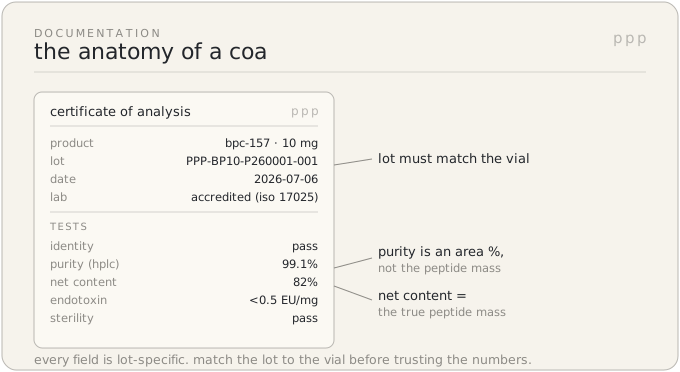
A Certificate of Analysis is a document, typically issued by an analytical laboratory, that reports the results of a defined set of tests performed on a specific batch of material at a specific point in time. It is a snapshot of analytical findings.
It is NOT:
- A guarantee of stability over time
- A statement of fitness for any particular research application
- A regulatory clearance or product approval
- A substitute for the researcher's own verification or quality control
A well-written COA tells you what the material was, at the time the test was performed. From that, an experienced researcher can make informed inferences about what the material likely is at the time it arrives in their lab, assuming proper storage and shipping, and how to use it appropriately.
The Standard Parameters
Most COAs for research-grade peptides report on some combination of the following parameters. Understanding what each measurement actually means is the foundation of reading a COA effectively.
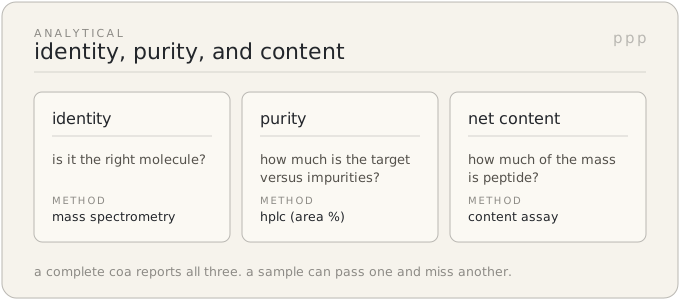
Identity
What it measures: Confirmation that the compound in the batch is the compound the label claims.
Typical method: Mass spectrometry (often MALDI-TOF or ESI-MS) and/or amino acid analysis. For peptides, the most common confirmation is matching the observed molecular weight to the theoretical molecular weight of the peptide sequence.
What "passing" looks like: The measured molecular weight matches the theoretical molecular weight within an acceptable tolerance, and any expected fragmentation patterns are observed.
Why it matters: A material that fails identity testing is not what its label claims, full stop. This is the most fundamental quality check.
Purity
What it measures: What percentage of the material in the batch is the target compound, versus impurities, degradants, or unrelated compounds.
Typical method: Reverse-phase High-Performance Liquid Chromatography (RP-HPLC), often combined with UV detection at a specific wavelength.
What "passing" looks like: A clean main peak corresponding to the target compound, with minimal minor peaks. Purity is reported as a percentage; research-grade peptides are typically expected to meet 95% or higher purity, with premium materials often at 98%+ or 99%+.
Why it matters: Impurities can affect experimental reproducibility, interact with experimental systems in unexpected ways, and complicate interpretation of results. Higher purity generally correlates with more reliable experimental outcomes.
What to watch for: "Purity" reported without the analytical method or wavelength stated. A purity claim without method context is less meaningful than a purity claim with full chromatographic documentation.
Net Content
What it measures: The actual mass of the labeled compound in the container, versus what the label states.
Typical method: Gravimetric analysis after accounting for non-target content (such as residual buffer salts or water of crystallization).
What "passing" looks like: Measured net content within a defined tolerance (typically ±5%) of the labeled mass.
Why it matters: A vial labeled "10mg" should contain 10mg (or very close to it) of the actual target compound. Significant deviation from labeled content affects every concentration calculation downstream.
Endotoxin
What it measures: The presence of bacterial endotoxins (lipopolysaccharides from gram-negative bacteria) at levels that could affect biological systems.
Typical method: Limulus Amebocyte Lysate (LAL) assay, kinetic chromogenic or turbidimetric.
What "passing" looks like: Endotoxin levels below a defined threshold, often reported in Endotoxin Units (EU) per mg of material.
Why it matters: Endotoxins can affect cellular responses in biological assays even at low levels. For in vitro work involving immune cells or systems sensitive to inflammatory signaling, endotoxin levels can confound results.
Sterility
What it measures: The absence of viable microorganisms in the material.
Typical method: Standard membrane filtration or direct inoculation methods per pharmacopeial standards (USP <71>).
What "passing" looks like: No growth of bacteria, fungi, or yeasts after the standard incubation period.
Why it matters: Sterility is critical for any research application involving cell culture or living systems.
Note: Sterility testing is not always included on COAs for non-sterile research materials. Whether sterility testing is appropriate depends on the intended use of the material.
Heavy Metals
What it measures: Trace levels of metallic contaminants, typically including arsenic, cadmium, lead, mercury, and sometimes others.
Typical method: Inductively Coupled Plasma Mass Spectrometry (ICP-MS) or atomic absorption spectroscopy.
What "passing" looks like: Each measured metal below its respective threshold, typically reported in parts per million (ppm) or parts per billion (ppb).
Why it matters: Heavy metal contamination can result from manufacturing processes or raw material quality and can produce experimental artifacts.
Variance (Batch-to-Batch Consistency)
What it measures: How closely the current batch's parameters match historical batches of the same product.
Typical method: Statistical comparison of current batch results to a running quality database of prior batches.
What "passing" looks like: Current batch parameters within historical norms.
Why it matters: Consistency from batch to batch supports reproducibility across experiments performed at different times.
What a Good COA Looks Like
Beyond the analytical content itself, a well-prepared COA includes several practical features:
- Clear identification of the testing laboratory, the lab's name, address, and accreditation status. Avoid COAs that don't identify who performed the testing.
- Specific batch or lot number, the COA should be traceable to a specific batch, not a generic product type.
- Date of testing, to provide context on the age of the analysis.
- Method documentation, references to the analytical methods used, ideally with version or method-number specificity.
- Signature or certification, a responsible analyst's signature or formal certification stamp.
A COA that lacks any of these features should prompt additional questions before relying on the documentation.
How to Use a COA in Practice
For most research applications, the practical workflow is:
- Receive material and locate the COA (typically included in the package or accessible via vendor portal)
- Verify identity and purity match the labeled product, if they don't, contact the supplier before proceeding
- Note the analytical date and consider material age, peptides typically remain stable in lyophilized form for extended periods when stored properly
- Cross-reference with previous batches if the same product is used recurringly, significant variance between batches may indicate supply-chain issues
- Retain the COA for the duration of the research project as part of the experimental record
Many institutional and regulatory frameworks require retention of COAs as part of research documentation. Even when not formally required, retaining COAs supports reproducibility and accountability.
Beyond the COA
A COA is a foundational quality document, but it is not the only quality signal worth considering. Other factors that complement COA review include:
- The vendor's overall compliance posture (see our vendor diligence article)
- The vendor's history of COA consistency over time
- Whether COAs are publicly accessible per product (rather than only available on request)
- The reputation and accreditation of the testing laboratory itself
Considered together, COA review and broader vendor diligence form the foundation of informed material selection. Treating these as routine practices, rather than occasional checks, materially improves the quality of the research conducted with the materials.
references
- U.S. Pharmacopeia, General Chapter <71> Sterility Tests. https://www.usp.org/
- U.S. Pharmacopeia, General Chapter <85> Bacterial Endotoxins Test. https://www.usp.org/
- International Council for Harmonisation of Technical Requirements for Pharmaceuticals for Human Use (ICH), Q2(R1) Validation of Analytical Procedures. https://www.ich.org/
- ISO/IEC 17025: General requirements for the competence of testing and calibration laboratories. https://www.iso.org/standard/66912.html
continue reading
research use only. sold for in-vitro laboratory research.
not for human or animal use.