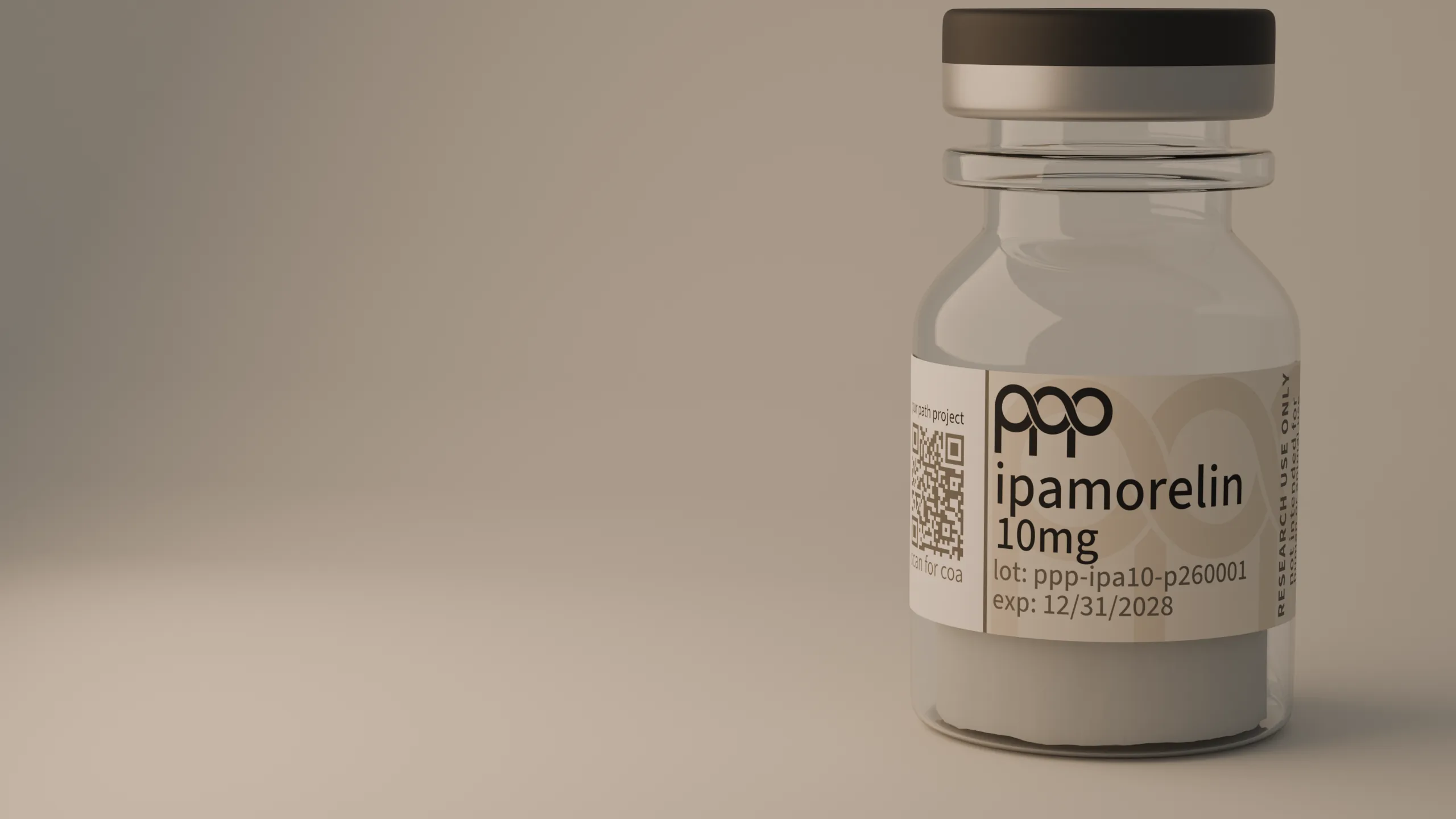
handling
storing and handling lyophilized research peptides
a laboratory reference for storing lyophilized research peptides: the three factors that drive degradation, and how lyophilized and reconstituted material differ.
Lyophilized (freeze-dried) research peptides are kept cold, dry, and dark, and the dry powder is far more stable than the reconstituted solution. How a peptide is stored between arrival and use directly affects whether an experiment is reproducible, because the same conditions that degrade a peptide also change the results it produces. This is the pillar reference for the handling cluster; the linked articles go deeper on stability chemistry and reconstitution.
why the lyophilized form is the stable one
Lyophilization removes water from a frozen peptide under vacuum, leaving a dry cake or powder. Most of the chemical reactions that degrade a peptide need water, or need the molecular freedom that only exists in solution. Take the water away and you take away the mobility, and the peptide becomes far more durable. That is the whole reason research peptides ship lyophilized rather than pre-dissolved.
The practical consequence: the powder is the resilient state, and the solution is the fragile one. Storage strategy follows directly from that fact.
the three factors that drive degradation
Almost everything about good storage comes down to controlling three influences, plus oxygen.
Temperature. Reaction rates fall as temperature drops. Colder storage slows every degradation pathway at once. Lyophilized peptides are generally kept frozen for long holding, with short-term refrigeration acceptable for material in active use.
Moisture. Because water enables degradation, keeping the powder dry preserves it. The most common handling error is condensation: taking a cold vial out into warm, humid air lets moisture condense onto and into the material. Allowing a sealed vial to reach room temperature before opening avoids this.
Light (and oxygen). Ultraviolet light drives oxidation of certain amino acid residues, and atmospheric oxygen does the same more slowly. Storing material in the dark, in its sealed container, limits both.
a working reference for storage
The specifics for any given peptide depend on its sequence and the research use, and the supplier's stated conditions and the batch Certificate of Analysis should govern. As a general laboratory reference, the following distinctions are widely observed:
| Lyophilized powder | Reconstituted solution | |
|---|---|---|
| Relative stability | High | Much lower |
| Typical holding | Frozen for long-term; refrigerated short-term | Refrigerated, used within a short window |
| Main risks | Moisture ingress, repeated warming | Hydrolysis, oxidation, aggregation, microbial growth |
| Handling note | Warm to room temperature before opening | Aliquot to avoid repeated freeze-thaw |
Two handling habits matter enough to call out:
Avoid repeated freeze-thaw. Each cycle of freezing and thawing stresses a peptide, particularly in solution, and can drive aggregation. Dividing a reconstituted solution into single-use aliquots before freezing means each portion is thawed once.
Minimize warming excursions of the dry powder. Every time a vial is taken out, warmed, and returned, it risks condensation and adds thermal exposure. Removing what is needed efficiently and returning the stock to cold storage promptly protects the remainder.
receiving and logging material
Good handling starts before storage. On arrival, the practical steps are to confirm the shipment against the order, note the condition of any temperature-controlled packaging, locate and file the batch Certificate of Analysis, and record the lot number against your own inventory. Retaining the COA for the life of the project is part of experimental record-keeping, and lets you cross-reference the exact lot later if a result needs explaining. How to read that certificate is covered in reading a Certificate of Analysis.
how storage connects to the underlying chemistry
Every storage rule here is a countermeasure to a specific degradation pathway. Cold slows hydrolysis and deamidation; dark and sealed slow oxidation; dry prevents the water-driven reactions; single-thaw aliquoting prevents physical aggregation. The mechanisms behind each are covered in peptide stability: the four degradation pathways, and the chemistry of moving from powder to solution is in reconstitution solvent chemistry.
frequently asked questions
How should lyophilized research peptides be stored?
As a general laboratory reference, lyophilized peptides are kept cold, dry, and protected from light, frozen for long-term holding and refrigerated for short-term active use. The supplier's stated storage conditions and the batch COA should govern for any specific peptide.
Why should a peptide vial reach room temperature before opening?
Opening a cold vial in warmer, humid air lets moisture condense onto the material. Because water drives degradation, allowing the sealed vial to warm to room temperature first limits moisture ingress.
Is lyophilized peptide more stable than reconstituted peptide?
Yes. Removing water during lyophilization removes the conditions most degradation reactions need, so the dry powder is substantially more stable than a solution, which is fragile by comparison and used within a shorter window.
Why is freeze-thaw a problem?
Repeated freezing and thawing physically stresses a peptide and can drive aggregation, especially in solution. Dividing a reconstituted solution into single-use aliquots means each portion is thawed only once.
references
- U.S. Pharmacopeia, General Chapter <1079> Good Storage and Distribution Practices for Drug Products. https://www.usp.org/
- International Council for Harmonisation, Q1A(R2) Stability Testing of New Drug Substances and Products. https://www.ich.org/
- U.S. Pharmacopeia, General Chapter <1191> Stability Considerations in Dispensing Practice. https://www.usp.org/
continue reading

research use only. sold for in-vitro laboratory research.
not for human or animal use.