handling
reconstitution solvent chemistry: a laboratory reference
the solvent chemistry behind dissolving a lyophilized research peptide: how solubility guides solvent choice and why the resulting solution is less stable.
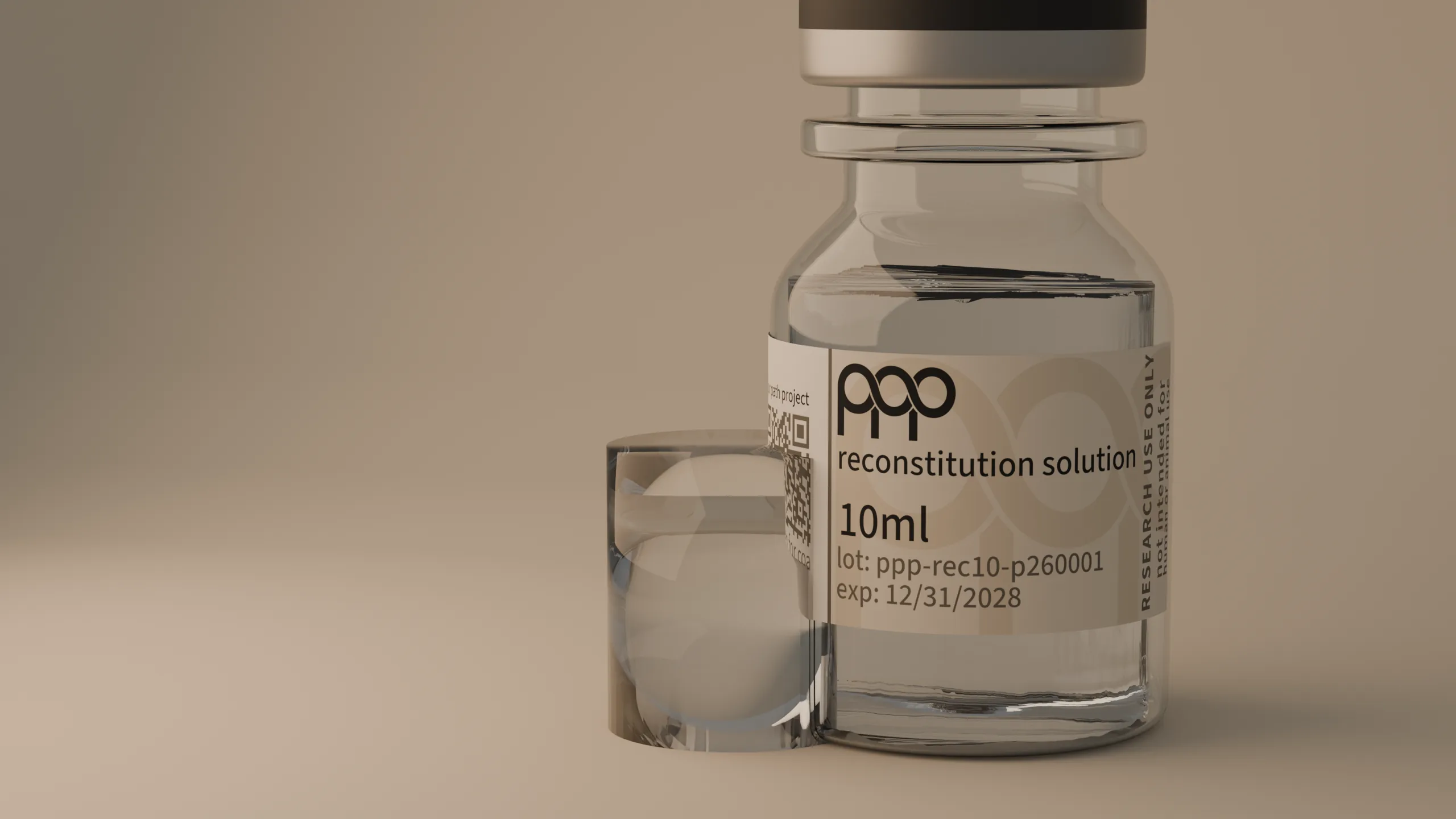
Reconstitution is dissolving a lyophilized peptide in an appropriate solvent for laboratory work, and the right solvent is the one that matches the peptide's solubility. This article explains the chemistry that governs that choice. It is a conceptual reference for how solvents and peptides interact, not a preparation recipe: specific solvents, concentrations, and procedures are determined by the experimental design and the published methods for a given research application.
the governing principle: like dissolves like
A peptide's solubility is set by its sequence. Peptides rich in charged or polar residues tend to be water-soluble; peptides rich in hydrophobic residues resist water and need a different approach. The whole of solvent selection follows from reading which category a peptide falls into, and matching the solvent's polarity to it. This is why there is no universal solvent: the correct choice is peptide-specific.
A common laboratory strategy for difficult peptides is to dissolve the material first in a small volume of a stronger solubilizing solvent, then dilute into the working aqueous medium. The dissolving step establishes a true solution; the dilution brings it to the conditions the experiment requires.
the common solvents and what governs their use
| Solvent | Suited to | Chemistry note |
|---|---|---|
| Sterile water | Readily water-soluble (hydrophilic) peptides | The simplest aqueous medium; contains no antimicrobial agent |
| Bacteriostatic water | Aqueous solutions held longer in the lab | Water with a small amount of benzyl alcohol that inhibits bacterial growth in the solution |
| Dilute acetic acid | Basic or poorly water-soluble peptides | Mild acidity assists solubility for many sequences |
| Dilute ammonium/base | Acidic peptides | Raises pH to assist dissolution of certain sequences |
| DMSO (dimethyl sulfoxide) | Strongly hydrophobic peptides | A powerful aprotic solvent; used in small solubilizing volumes, with attention to its compatibility with the downstream assay |
Two chemistry points behind that table are worth drawing out.
Bacteriostatic versus sterile water is about the solution's lifetime, not just sterility at the moment of mixing. Sterile water is free of organisms when used, but a solution sitting in a lab can be re-contaminated or support growth over time. Bacteriostatic water contains benzyl alcohol, which suppresses bacterial growth in the standing solution. The choice depends on how the solution will be handled and for how long, and on whether benzyl alcohol is compatible with the experimental system. Contamination control connects directly to sterility testing and USP <71>.
DMSO is potent but not free. It dissolves peptides that water cannot, but it can interfere with biological assays at meaningful concentrations, so it is typically used in the smallest volume that achieves dissolution and then diluted. Its compatibility with the specific research system has to be considered, not assumed.
the solution is the fragile state
The reconstituted solution is far less stable than the lyophilized powder it came from. Dissolving the peptide restores exactly the conditions, water and molecular mobility, that the degradation pathways need. In practice this means a reconstituted solution has a limited working window and benefits from the same countermeasures covered in peptide stability: keep it cold, keep it dark, and divide it into single-use aliquots so no portion is subjected to repeated freeze-thaw. The storage logic for both states is set out in the pillar, storing and handling lyophilized research peptides.
a note on filtration and technique
For laboratory work requiring low bioburden, solutions are often passed through a fine (for example 0.22 micron) filter, which removes particulates and microorganisms, and handled with aseptic technique. Whether this is necessary, like everything else here, is dictated by the research application rather than by a fixed rule.
the boundary of this article
Everything above is solvent chemistry: which solvents suit which peptides, and why. It is deliberately not a set of volumes, concentrations, or preparation steps, because those are properties of a specific experiment and its published methodology, not of a compound in the abstract. Researchers determine them from their experimental design and the relevant literature.
frequently asked questions
What solvent is used to reconstitute a peptide?
It depends on the peptide's solubility. Water-soluble (hydrophilic) peptides dissolve in aqueous media; poorly soluble or hydrophobic peptides may require dilute acid, base, or a small volume of a stronger solvent such as DMSO before dilution. The correct solvent is peptide-specific and set by the experimental design.
What is the difference between bacteriostatic and sterile water?
Sterile water contains no microorganisms at the point of use but no preservative. Bacteriostatic water contains a small amount of benzyl alcohol that inhibits bacterial growth in a solution held over time. The choice depends on how long the solution will be kept and whether benzyl alcohol is compatible with the experimental system.
Why is a reconstituted peptide less stable than the powder?
Dissolving the peptide restores the water and molecular mobility that degradation reactions require. The solution therefore has a much shorter working window than the lyophilized powder and benefits from cold, dark storage and single-use aliquoting.
Why is DMSO used for some peptides?
DMSO is a strong aprotic solvent that dissolves hydrophobic peptides water cannot. Because it can interfere with biological assays at higher concentrations, it is typically used in the smallest volume needed to dissolve the material and then diluted, with attention to assay compatibility.
references
- U.S. Pharmacopeia, General Chapter <1191> Stability Considerations in Dispensing Practice. https://www.usp.org/
- U.S. Pharmacopeia, General Chapter <71> Sterility Tests. https://www.usp.org/
- International Council for Harmonisation, Q5C Stability Testing of Biotechnological/Biological Products. https://www.ich.org/
continue reading

research use only. sold for in-vitro laboratory research.
not for human or animal use.